
Why Wood Feels Like Home
There's something in a wooden room that no other material quite replicates. It isn't just aesthetics. It's something older than taste.
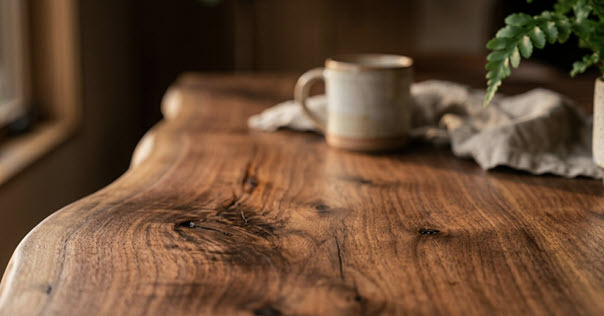
Walk into a room paneled in warm oak and something shifts almost immediately. Your breathing slows. Your shoulders drop a centimeter. The conversation softens. You probably haven’t consciously registered the material on the walls; you’re just aware that the room feels good. This is not coincidence, and it is not simply a matter of style. The calming effect of wood in interior space has been documented in enough research now that it’s worth taking seriously as a design principle rather than a vague aesthetic preference.
The question worth asking is: why? What is it about the particular texture, color, and grain of wood that produces this measurable shift in how we feel?
A million years of memory
The most compelling explanation begins before recorded history. For the vast majority of human existence, hundreds of thousands of years before concrete, steel, or glass, wood was the dominant material in the built environment. Trees provided shelter, fuel, tools, and food. To be near wood was to be near resources, near safety, near life. To be in open, treeless terrain, by contrast, was to be exposed.
Evolutionary psychologists call this biophilia: the innate human tendency to seek connection with nature and living systems. The term was popularized by biologist E.O. Wilson in the 1980s, but the concept speaks to something far older than the word. The theory holds that our nervous systems developed in close relationship with natural environments, and that this history is encoded in us, not as memory exactly, but as a kind of baseline expectation. When we encounter natural materials, particularly wood, something in us recognizes it as a signal of safety.
This isn’t romanticism. It’s neurology.
What the research actually shows
Over the past two decades, a growing body of research, much of it coming out of Japan, Austria, and Scandinavia where wood culture in architecture runs deep, has begun to quantify what designers and dwellers have long sensed.
Studies in Austria compared stress responses in school children across classrooms built with varying amounts of exposed wood. The findings were consistent: children in wood-rich environments showed lower cortisol levels, a primary stress hormone, over the course of the school day than those in conventional rooms. Heart rate was lower. Subjective reports of stress were also lower. Similar results have been replicated in hospital environments, where patients in rooms with wood elements required less pain medication and were discharged faster on average than those in standard clinical rooms.
One of the most referenced mechanisms is what researchers call the “1/f” pattern, a mathematical property found in natural systems. The grain of wood, like the sound of running water or the movement of a candle flame, exhibits this pattern: variation that is neither fully random nor perfectly regular, but somewhere between the two. This specific quality appears to be unusually easy for the brain to process. When the visual system encounters it, attentional effort decreases. The brain, in a sense, can relax.
The grain of wood, like the sound of running water or the movement of a candle flame, exhibits a pattern the brain finds unusually easy to process. Attentional effort decreases. The brain, in a sense, can relax.
This is why staring at the grain of a wooden table during a long meeting is not distraction. It is, quite literally, rest.
Warmth is not metaphor
There is also the question of temperature, both actual and perceived. Wood is a genuine thermal insulator. It holds warmth and releases it slowly, making a wood-surfaced room feel warmer at the same air temperature than a room dominated by stone, tile, or metal. But the warmth we associate with wood runs deeper than thermal conductivity.
Cognitive psychology has documented what researchers call “embodied cognition”: the idea that physical sensations and abstract concepts share representational space in the brain. Warmth and social trust, for instance, appear to be linked in this way. A person holding a warm drink rates strangers as more trustworthy than someone holding a cold one. This bleed between sensation and judgment seems to extend to interiors. A warm-toned room doesn’t just feel physically warmer; it feels emotionally warmer too. And few materials are more reliably warm in both tone and texture than wood.
The color range of most common domestic wood species, from the pale gold of pine to the reddish brown of cherry to the deep amber of walnut, sits within what color theorists call the “earth tone” spectrum. These colors register to our visual system as natural, familiar, and low-threat. They evoke soil, bark, sand, and dried grass: the palette of the landscapes where we spent most of our evolutionary history.
Imperfection as comfort
There is another quality of wood that rarely gets named directly in design conversations: its refusal to be perfect. Every plank is different. Knots, checks, grain variations, slight color shifts — wood carries the record of its own life. The tree it came from grew in a specific place, responded to specific seasons, survived specific stresses. That history is visible in the material.
This imperfection is not a flaw to be corrected. It is, paradoxically, part of what makes wood feel safe. Perfectly uniform surfaces, glossy, seamless, machine-made, trigger a very different kind of attention. They invite scrutiny. They demand that we notice if anything is wrong. Natural variation, by contrast, signals that everything is already working as it should. The irregularity is the point.
The Japanese aesthetic concept of wabi-sabi captures this directly: a recognition that beauty is found not in spite of imperfection, age, and incompleteness, but because of it. Wood ages visibly. It darkens, develops a patina, shows wear in the places it is touched most often. A well-used wooden floor tells the story of a life lived in a space. That record, far from making the material feel degraded, makes it feel inhabited. Inhabited spaces feel safe. Safe spaces feel like home.
The material in modern context
Contemporary interior design has not overlooked any of this. The steady popularity of Scandinavian minimalism, the revival of mid-century modernism, the current enthusiasm for biophilic design: all of them place natural wood at the center. What shifts across these movements is proportion, finish, and pairing, not the underlying preference for the material itself. That preference appears to be consistent across cultures and generations.
What changes is how we justify it. For a few decades in the latter half of the twentieth century, the design conversation leaned heavily on industrial materials, glass, concrete, steel, as expressions of modernity and progress. Wood retreated into a supporting role, used where warmth was needed but often treated apologetically, as a concession to comfort rather than a genuine design choice. That era has largely passed. The research on stress and environment, combined with a broader cultural shift toward the natural and the tactile, has restored wood to something close to its original standing in the built environment.
There is also a growing awareness that the psychological benefits of natural materials are not a luxury. They are relevant to schools, hospitals, offices, and housing: any space where people spend time under stress. The evidence that wood reduces that stress is now substantial enough that it is beginning to influence building codes and institutional design standards in countries like Japan and Austria. What began as intuition has become something more like science.
What this means in practice
None of this requires a wholesale renovation. The calming effect of wood scales with quantity; more is generally more effective, but even small interventions matter. A wooden cutting board on a kitchen counter. A timber bookshelf in a room that is otherwise all paint and plaster. A solid wood dining table in a space that has been furnished primarily in upholstery and glass. These additions work because the nervous system is not asking for a forest. It is asking for a signal. Wood, in almost any quantity, provides one.
The grain, the warmth, the slight imperfection: together they say something that no synthetic material quite manages to replicate. They say this came from somewhere living. They say you are in a place that was worth building. They say, in some register below conscious thought, that you can put your guard down now.
That is a remarkable thing for a material to communicate. It is also, given everything we know about where we came from and what our nervous systems are still expecting to find, not surprising at all.